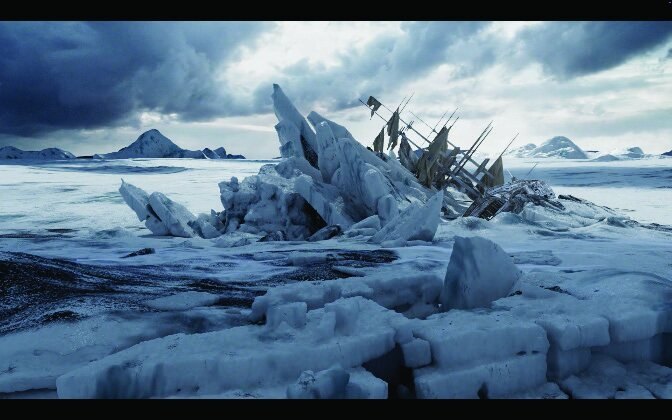
After Caspar David Friedrich’s The Sea of Ice, 1824–2024 treats Friedrich’s 1823–24 painting as a historical, political, and climatic model rather than a fixed image. Painted in the aftermath of the Napoleonic Wars, Das Eismeer has long been read as a record of collapsed hope — the failure of the Enlightenment-nationalist dream that military conflict might deliver German unification, with its crushed ship standing for ambition immobilized rather than fulfilled. Kessler treats the painting as a suspended historical threshold: made at the onset of modernity, before the industrial transformations that eventually brought unification and, with it, the conditions for two World Wars and the ecological crises of the twentieth and twenty-first centuries.
The project extends that threshold forward using two centuries of actual climate data. A three-dimensional reconstruction of Friedrich’s composition is altered according to recorded temperature increases and glacier retreat, running continuously from 1824 to 2024 in a five-minute animation: the ice fractures, the ship gradually disappears, and by 2025 almost nothing solid remains. Thirteen charcoal drawings (100 × 130 cm each, framed with passe-partout and oak frame) translate specific decades of that simulation by hand — 1823–24, 1890, 1910, 1930, 1950, 1960, 1970, 1980, 1990, 2000, 2010, 2015, and 2025 — each one both an image and a document of loss. Charcoal itself is carbon, made from burned organic matter, which Kessler treats as an apt material for rendering the history of climate collapse: a record of combustion recording a record of warming.
Friedrich is a complicated inheritance — reportedly Hitler’s favorite painter, his reputation collapsed after World War II and was only rehabilitated in the 1970s. Kessler’s animation arrives in the wake of a recent wave of major Friedrich retrospectives (Hamburger Kunsthalle and Berlin Nationalgalerie, both 2024; the Metropolitan Museum of Art’s first US Friedrich retrospective, 2025) that positioned the painter at the center of the current climate conversation; Kessler’s project supplies what those survey shows could not — actual data, duration, and collapse rendered as a durational image rather than implied through curatorial juxtaposition. At the Johanniterkirche Feldkirch, the work is shown in the nave alongside two other pieces (Nowhere to Be Found and Making Something Out of Nothing) as one of three simultaneous, irreversible processes staged across the building: bone becoming coral, plastic becoming permanent, ice becoming water.